Missed Call Text-Back: How to Stop Losing Jobs to Voicemail
Key Takeaways
- A 2024 study of 85 small businesses across 58 industries found only 37.8% of calls were answered by a live person — 37.8% went to voicemail and 24.3% got no response at all, meaning roughly 62% of incoming calls went unanswered. [411 Locals, 2024]
- Responding within 5 minutes makes you up to 100x more likely to connect with a lead than responding after 30 minutes. [MIT/InsideSales Lead Response Management Study, 2007, via Harvard Business Review]
- Most callers who hit voicemail don't leave a message — they hang up and call the next result on Google instead.Missed call text-back automation closes that gap by texting a missed caller within seconds, so the conversation continues even when the phone wasn't answered.This article is for trades, contractors, cleaners, and agencies who are on jobs, on tools, or with clients all day and physically can't pick up every call.
The Hidden Cost of a Missed Call
For a service business, a missed call isn't a missed conversation — it's a missed job. The person calling almost always has three or four other businesses open in another tab, and they're working down the list until someone answers.
A 2024 study by 411 Locals, which tracked call handling across 85 small businesses in 58 industries, found that only 37.8% of incoming calls were picked up by a live person. The rest split almost evenly between voicemail (37.8%) and no response whatsoever (24.3%) — meaning close to 62% of calls never got a real-time answer. For a trade or service business running on referrals and Google searches, that's not a minor leak. That's most of your inbound demand going to voicemail or nowhere at all.
Why Voicemail Doesn't Work Anymore
Voicemail was built for a world where people were willing to wait for a callback. That world doesn't exist for service businesses anymore. A caller with a burst pipe, a broken air conditioner, or an urgent job to quote isn't leaving a message and waiting by the phone — they're hanging up and calling the next business that shows up in the search results.
That's the real problem with treating voicemail as your safety net: it assumes the lead will wait. In a competitive, multiple-quote market, they won't. The business that gets back to them first — by call or by text — usually gets the job, almost regardless of price or reputation, simply because they were first to respond.
This is the same dynamic behind speed to lead [Link "speed to lead" to: /blog/speed-to-lead-service-businesses]: the MIT/InsideSales study found that calling a lead within 5 minutes makes you up to 100x more likely to actually connect with them, compared to waiting 30 minutes. Voicemail doesn't just delay that response — for most callers, it ends it.
What Is Missed Call Text-Back?
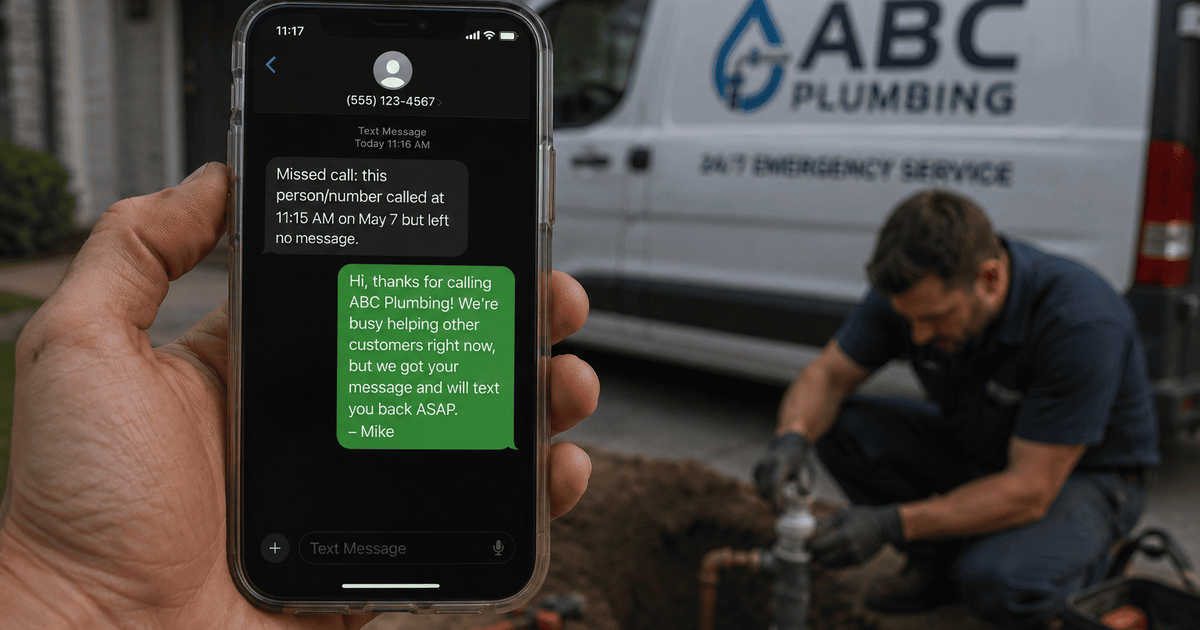
Missed call text-back is automation that does one simple thing: the moment a call to your business goes unanswered, the caller automatically receives a text message — instantly, without anyone touching a phone.
A typical message looks like this:
"Hi, sorry we missed your call! This is [Business Name] — we're on a job right now but will call you back shortly. In the meantime, what can we help with?"
That single text changes the outcome of the call. Instead of a caller assuming nobody's there and moving on, they get an immediate signal that the business is real, active, and already responding. Most people will reply to the text with exactly what they need — a quote, a callout, a booking — and that reply lands in your phone as a normal message you can answer between jobs.
Old Way vs New Way
- Response time — Old way: hours, if at all. New way: seconds.
- Caller experience — Old way: recorded message, no certainty anyone heard it. New way: instant text confirming the business is responsive.
- Likely caller action — Old way: hangs up, calls the next business. New way: replies with the job details.
- Who has to act — Old way: you, manually, when you get a free moment. New way: the system, automatically, the instant the call is missed.
- What happens after hours — Old way: nothing until you're back at the phone. New way: lead is captured and waiting for you, with their details already on record.
How AI Closes the Missed-Call Gap
Text-back is the starting point — but a missed call is just one type of lead. The same automation that catches a missed call should also catch a website enquiry, a form fill, or an after-hours message, and route all of it into one place so nothing gets followed up from memory.
This is the model behind Alpsaxis's AI Lead & Booking System:
- Automatic text-back fires within seconds of every missed call, so no caller is left wondering if anyone's there.
- AI chat on your website captures and answers enquiries 24/7, including after hours when many calls go unanswered in the first place.
- A CRM pipeline logs every missed call, text reply, and enquiry in one place, so leads are tracked instead of living in a call log nobody checks.
- Booking automation lets a replying lead lock in a time directly from the text thread, without a back-and-forth.
- It layers onto a phone number and website you already have — no new hardware, no rebuild — and is typically live within 7–10 days.
FAQ
Does missed call text-back work with my existing business number?
Yes. It connects to the number customers already call — no new number to advertise, and no apps for callers to download. The text simply comes from your business as normal.
Will customers find an automated text annoying?
Most don't, because it solves their immediate problem: not knowing if anyone is there. An instant "we saw your call, here's what's next" message reads as good service, not spam — the frustration comes from silence, not from a quick reply.
What happens if the lead doesn't reply to the text?
A good system follows up again automatically — a second text, then a call attempt — instead of leaving it to one message and hoping. The goal is the same structured follow-up used for any other lead source.
Is this only useful for trades, or does it work for other service businesses?
It works anywhere a phone call is the way customers reach you and being unreachable costs you the job — trades, clinics, cleaners, agencies, and consultants all see the same pattern.
How is this different from just turning on voicemail-to-text?
Voicemail-to-text still requires the caller to leave a message, which most won't do. Missed call text-back skips that step entirely and reaches out the instant the call is missed, before the caller has decided to give up.
The Bottom Line
Every missed call is a lead that's still live for a few minutes — and then it isn't. Voicemail asks the caller to wait; missed call text-back gets to them first, automatically, even while you're up a ladder or under a sink. For service businesses already winning on the quality of the work, this is one of the simplest fixes available: stop losing jobs to silence.
If your business is missing calls during jobs and losing them to whoever answers next, book a call and we'll show you what automatic text-back and lead booking would look like for your business.