Speed to Lead: Why the First 5 Minutes Decide Whether You Win the Job
Key Takeaways
- Firms that contact a lead within an hour are nearly 7x more likely to qualify it than those who wait even an hour longer — and over 60x more likely than those who wait a day (Harvard Business Review, 2011)
- The average company takes 42 hours to respond to a web lead, despite the conversion cliff happening in the first five minutes.
- Calling within 5 minutes makes you 100x more likely to connect with a lead, and 21x more likely to qualify them, compared to waiting 30 minutes (MIT/InsideSales Lead Response Management Study, 2007)
- "Speed to lead" can be fixed without hiring a receptionist — AI chat and automated SMS/email sequences close the gap 24/7.- This article is for trades, clinics, coaches, and other service businesses that already generate enquiries but lose too many of them after the first contact.
What Is Speed to Lead?
Speed to lead is the amount of time between a prospect submitting an enquiry — a form fill, a missed call, a DM — and your business making first contact back. It is one of the strongest predictors of whether that enquiry turns into a paying client, because most buyers are comparing two or three providers at once. Whoever responds first usually frames the conversation, and the rest become afterthoughts.
For service businesses specifically — where the buying decision is made on trust and urgency rather than browsing a catalogue — speed to lead matters even more than it does for e-commerce. A homeowner with a burst pipe, a patient booking a consultation, or a business owner shopping for a contractor will typically go with whoever calls back first, not whoever eventually sends the best quote.
The Data: Why Response Time Is the Real Conversion Lever
The numbers on this are not anecdotal — they come from two of the most-cited studies in sales research.
Harvard Business Review (2011) — Researchers James Oldroyd, Kristina McElheran, and David Elkington audited 2,241 US companies and their handling of web-generated leads.
They found:
- Average first-response time: 42 hours
- Responded within 1 hour: 37% of firms
- Responded within 24 hours: 16% more
- Never responded at all: 23% of firms
- Contact-within-1-hour vs. 1+ hour later: ~7x more likely to qualify the lead Contact-within-1-hour vs. 24+ hours: 60x+ more likely to qualify the lead
MIT / InsideSales.com Lead Response Management Study (2007) - A separate study of six companies, more than 15,000 leads, and over 100,000 dials found an even sharper cliff inside the first half hour:
- Calling within 5 minutes makes you 100x more likely to connect with the lead than calling after 30 minutes.
- Calling within 5 minutes makes you 21x more likely to qualify the lead than calling after 30 minutes.
Put plainly: most service businesses aren't losing jobs because their pricing or quality is worse. They're losing jobs because somebody else picked up the phone first.
Why Service Businesses Are Especially Exposed
A few patterns show up again and again in trades, clinics, and consulting practices:
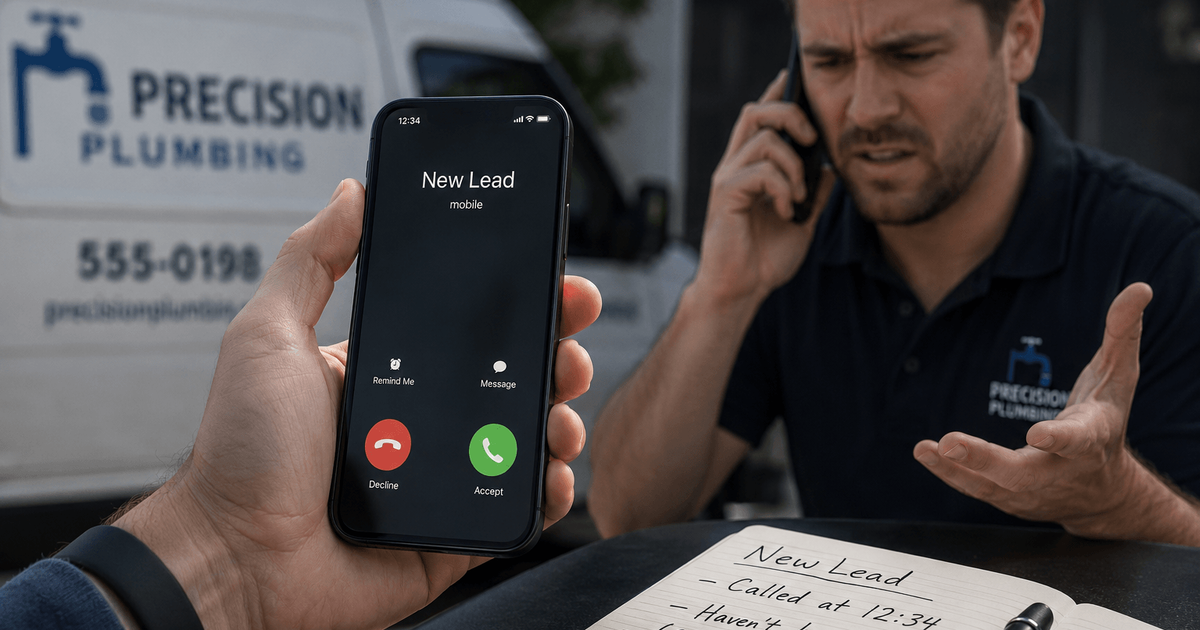
- Enquiries land after hours. A plumber, electrician, or coach is often on a job or with a client when the enquiry comes in — exactly when they can't respond.
- One person wears every hat. Owner-operators are doing the work, the quoting, and the admin. Follow-up gets pushed to "later," and later becomes never.
- Missed calls don't get a callback. A call that rings out rarely gets a follow-up text, even though the prospect is actively comparing options right now.
- Manual follow-up doesn't scale. Even a disciplined business can keep up with five enquiries a week. At twenty, something gets dropped.
None of these are quality problems. They're response-time problems — and response-time problems are the easiest ones to fix with automation.
The 5-Minute Rule in Practice
The "5-minute rule" popularised by the MIT study isn't about being frantic — it's about removing the human delay between "someone shows interest" and "someone hears back from you." In practice, a business hitting this standard usually has three things in place:
1. Instant acknowledgement. The moment a form is submitted or a call is missed, the lead gets an automatic SMS or email confirming they've been received — even before a human looks at it.
2. A first real response inside minutes, not hours. Either an AI assistant answers their specific question immediately, or a templated-but-personal follow-up goes out triggered by the enquiry itself.
3. A structured nurture sequence for anyone who doesn't book straight away. Most leads don't convert on the first touch — they convert on the third or fourth, days later, automatically.
How AI Closes the Speed-to-Lead Gap
This is exactly the gap an AI website closes that a passive brochure site can't. Instead of relying on a human to notice and respond to every enquiry, the system does it the moment the enquiry happens:
- AI chat on your site answers common questions and captures contact details 24/7, including outside business hours when most after-hours enquiries are made and lost.
- Automated SMS + email follow-up fires within minutes of every enquiry, closing the exact window the MIT and HBR studies identify as the highest-value moment.
- A CRM pipeline makes sure no enquiry sits untouched, because every lead is tracked rather than living in a missed-calls list or a forgotten inbox.
- Appointment reminders reduce no-shows once the lead is booked, protecting the conversion you just won.
This is the model behind Alpsaxis's AI Lead & Booking System — it layers onto a website you already have, with no rebuild required, and is typically live in 7–10 days.
A Practical Speed-to-Lead Checklist
Use this to audit your own response process this week:
- Time how long it actually takes your business to respond to a new web enquiry, end to end — not how long you think it takes.
- Set up an instant auto-acknowledgement (SMS or email) for every form submission.
- Add automatic text-back for missed calls so no enquiry goes silent.
- Build a 3–5 touch follow-up sequence for leads that don't book on the first contact.
- Track every enquiry in one pipeline so nothing is followed up from memory.
- Review response-time data monthly — what gets measured gets fixed.
FAQ
What counts as a "lead" for speed-to-lead purposes?
Any new enquiry from a prospective client — a website form, a missed phone call, a DM, or a booking request. Each one starts a response-time clock the moment it lands, whether or not a human has seen it yet.
Is speed to lead only relevant for sales-heavy businesses?
No. It applies anywhere a prospect compares providers before committing — trades, clinics, consultants, and coaches all see the same pattern: whoever responds first usually wins the work, regardless of who eventually does the best job.
Can I fix speed to lead without hiring a receptionist?
Yes. AI chat and automated SMS/email sequences can acknowledge and qualify a lead in seconds, then route anything urgent straight to you — without adding headcount or being tied to office hours.
How fast is "fast enough"?
The data points to minutes, not hours: response within 5 minutes converts dramatically better than 30 minutes, and response within an hour outperforms anything same-day or later. Treat one hour as the absolute ceiling, and five minutes as the target.
Does automated follow-up feel impersonal to leads?
Not when it's done well. An instant acknowledgement plus a genuinely helpful first response feels like good service, not spam — most prospects only feel ignored when nobody replies at all.
The Bottom Line
Speed to lead is one of the few growth levers backed by hard, replicated data rather than guesswork: respond within minutes and you multiply your odds of winning the job; wait hours and you've likely already lost it to a competitor who didn't.
For service businesses juggling the actual work alongside sales, the fix isn't working faster — it's removing the delay between "lead arrives" and "lead hears back" with automation that runs even when you can't.
If your business is generating enquiries but losing too many of them to slow follow-up, book a call with us and we'll show you what an AI-powered follow-up system would look like for your specific business.