AI Receptionist vs Answering Service: Which One Actually Books the Job?
Key Takeaways
- An AI receptionist is software that answers calls, texts back, and books appointments automatically; a traditional answering service is a human call centre that takes messages or transfers calls on your behalf.
- Traditional answering services typically cost $0.75–$1.95 per minute or $100–$400+ per month for moderate call volume, with extra charges for overflow minutes, holidays, and bilingual support.
- 31% of callers will only tolerate up to five minutes on hold, and 54% hang up within eight minutes. [Nextiva's Customer Patience Benchmark survey]
- 51% of small businesses have already integrated AI into customer service operations, but only 32% are currently using voice AI or IVR specifically. [Talkdesk/Pollfish survey, August 2025]
- This article is for trades, clinics, contractors, and coaching businesses comparing the two options to handle calls they can't personally answer.
What's the Difference Between an AI Receptionist and an Answering Service?
An AI receptionist is software — usually a voice agent or chat-and-text system — that answers incoming calls, responds to texts, and can book appointments directly into your calendar without a human involved. A traditional answering service is a call centre staffed by people who pick up your calls, take a message, and either relay it to you or transfer the caller, depending on your plan.
Both solve the same surface problem: someone (or something) other than you answers the phone. They solve it very differently once you look at speed, cost, and what happens after the call ends.
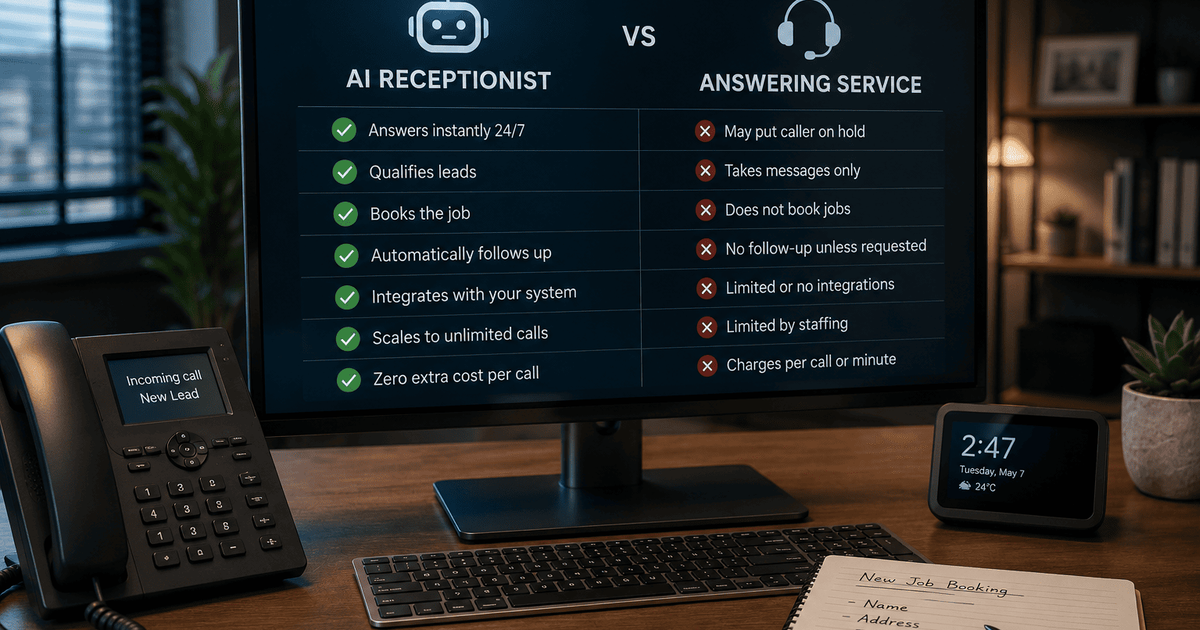
AI Receptionist vs Answering Service: Side-by-Side Comparison
- Cost structure — AI Receptionist: flat monthly fee, usually unaffected by call volume. Answering Service: $0.75–$1.95 per minute, or $100–$400+/month for moderate volume, plus overflow charges.
- Availability — AI Receptionist: 24/7/365, no staffing gaps. Answering Service: 24/7 plans exist, but often at a premium tier; holiday/after-hours coverage frequently costs extra.
- Response speed — AI Receptionist: instant, answers on the first ring every time. Answering Service: depends on operator availability; calls can queue during busy periods.
- Booking capability — AI Receptionist: can check your calendar and book directly, in the same call or text. Answering Service: takes a message or transfers the call; booking usually requires you to follow up.
- Follow-up after the call — AI Receptionist: can auto-text a quote request, send a booking link, or trigger a follow-up sequence. Answering Service: ends at the message — follow-up is on you.
- Scalability — AI Receptionist: handles 1 call or 100 simultaneously at the same cost. Answering Service: more simultaneous calls usually means a higher-tier (more expensive) plan.
- Consistency — AI Receptionist: same script, same tone, every call, every time. Answering Service: varies by which operator picks up and how busy the centre is.
Why Cost Adds Up Faster Than It Looks With a Human Answering Service
The advertised per-minute rate on an answering service looks small until you do the math on real call volume. At $0.75–$1.95 per minute, a business taking 200 calls a month averaging two minutes each lands at $300–$780 a month before overage minutes, holiday coverage, or bilingual support are added — and most providers charge extra for all three.
An AI receptionist is typically priced as a flat monthly fee that doesn't move with call volume, because the "staffing" is software, not headcount. For a service business with unpredictable enquiry volume — busy one week, quiet the next — that's the difference between a cost that scales with your phone ringing and one that doesn't.
Why Speed Still Decides Who Wins the Job
A caller doesn't know or care whether your phone is being answered by a person or software — they care how fast someone picks up and how useful that answer is. The data on hold times is unambiguous: in Nextiva's Customer Patience Benchmark survey of 400 consumers, 31% will only wait up to five minutes on hold, and 54% hang up within eight minutes — and a hung-up caller rarely calls back, they call the next business on the list instead.
This is the same dynamic covered in Speed to Lead: Why the First 5 Minutes Decide Whether You Win the Job [Speed to Lead: Why the First 5 Minutes Decide Whether You Win the Job] — whoever responds first usually wins the work, and an AI receptionist removes the queue entirely by picking up on the first ring, every time, rather than depending on which operator happens to be free.
Booking the Job vs. Just Taking a Message
This is the gap that matters most for service businesses specifically. A traditional answering service's job ends when the message is taken or the call is transferred — booking the appointment is still a manual step you or your team has to do afterward.
An AI receptionist can go a step further inside the same interaction:
- Check real-time calendar availability and offer the caller a slot, instead of promising a callback.
- Confirm the booking by text immediately, so the appointment is locked in before the caller hangs up.
- Capture job details (the type of work, the address, urgency) so you walk into the job already briefed.
- Trigger a follow-up sequence automatically for anyone who doesn't book on the call — closing the same gap covered in Missed Call Text-Back: How to Stop Losing Jobs to Voicemail. [Missed Call Text-Back: How to Stop Losing Jobs to Voicemail]
A message says "someone called." A booking says "you have a job on Thursday at 10am." For a business trying to fill the calendar, the second one is the only outcome that actually matters.
Scalability: What Happens When Call Volume Spikes
A busy storm season, a viral social post, or a seasonal rush can double your call volume overnight. With a human answering service, more simultaneous calls usually means upgrading to a higher-volume (and higher-cost) plan, and even then, a busy period can still mean callers wait in a queue.
An AI receptionist handles one call or a hundred at the same time, at the same cost, because it isn't bound by how many operators are on shift. For service businesses with seasonal or unpredictable demand — trades after a storm, clinics during flu season — that consistency matters more than it sounds, because it's exactly when missing calls is most expensive.
Which One Should You Actually Choose?
Neither option is wrong — they fit different situations:
- Choose a traditional answering service if your call volume is low and predictable, your enquiries are simple message-taking, and a human voice for every call matters more to you than booking automation.
- Choose an AI receptionist if you want every call answered instantly regardless of volume, you want the caller booked into your calendar without extra manual steps, and you want the same speed and consistency at 2am as at 2pm.
For most trades, clinics, and service businesses fielding enquiries around jobs rather than complex account issues, the AI receptionist model — paired with automated booking and follow-up — closes more of the gap between "phone rings" and "job booked."
FAQ
Is an AI receptionist as good as a real person on the phone?
For straightforward tasks — answering FAQs, checking availability, booking an appointment — modern AI receptionists handle the call smoothly and consistently. For highly complex or sensitive conversations, a hybrid setup that escalates select calls to a human is usually the better fit.
How much does an AI receptionist cost compared to an answering service?
AI receptionists are typically a flat monthly fee unaffected by call volume, while answering services charge $0.75–$1.95 per minute or $100–$400+ per month for moderate volume, plus overage and holiday surcharges. For unpredictable call volume, the flat-fee model is usually cheaper over time.
Can an AI receptionist actually book appointments, or just take messages?
Yes — unlike a traditional answering service, a properly configured AI receptionist can check calendar availability and confirm a booking in the same call or text, rather than just relaying a message for you to follow up on later.
Will customers know they're talking to AI instead of a person?
Often not, with current voice AI quality, though best practice is to disclose it upfront. Most callers care more about getting a fast, accurate answer than about who or what is answering, especially when the outcome is a confirmed booking.
Do I need to choose just one — AI receptionist or answering service?
No. Many service businesses run an AI receptionist for instant response and booking, with calls escalated to a human only when the caller specifically asks for one or the request is too complex for the AI to resolve.
The Bottom Line
An answering service and an AI receptionist both answer the phone when you can't — but only one of them can also book the job, follow up automatically, and scale to a busy week without a bigger bill. For service businesses where speed and follow-through decide who wins the work, the AI receptionist model closes more of that gap, at a more predictable cost.
If you're weighing up how to handle calls you can't personally answer, book a call and we'll show you what an AI receptionist would look like wired into your specific booking process.